

I’ve been exploring more and more AI tools lately, and Vibe Coding has completely transformed how I approach software development. In short, Vibe Coding is simply providing instructions to an AI model and letting it write the code for you. But there’s so much more to it than that. In this comprehensive guide, I’ll walk you through exactly what Vibe Coding is, the best tools available right now, which AI models excel at writing code, and a step-by-step process to get you started creating functional software without any prior coding experience.
Just a year ago, I had zero coding experience. Now, I’ve created multiple functional applications using Vibe Coding techniques. The barrier to entry for software development has never been lower, and I’m excited to show you how you can bring your ideas to life regardless of your technical background.
Key Takeaways
- Vibe Coding is an AI-powered approach where you describe what you want in natural language, and AI generates functional code without requiring manual coding skills.
- Tools like VS Code with the Cline extension and Claude 3.7 Sonnet provide the most powerful Vibe Coding experience currently available, with both free and paid options.
- You can create anything from websites to mobile apps to desktop applications using Vibe Coding, even with zero prior programming experience.
Requirements
- A computer capable of running a modern code editor (no specialized hardware needed)
- Visual Studio Code (VS Code) or Cursor installed on your computer
- The Cline extension for VS Code (or similar AI coding assistant)
- An active internet connection to access AI models
- Basic understanding of how to prompt AI effectively (which I’ll cover in this guide)
Why Use Vibe Coding?
Vibe Coding represents a fundamental shift in how software is created. Instead of spending months or years learning programming languages, frameworks, and development environments, you can focus on your ideas and let AI handle the technical implementation.
The term “surrendering to the vibes” perfectly captures the approach – you accept AI-generated code without needing to understand every detail, which enables:
- Rapid prototyping – quickly turn ideas into working prototypes without writing code manually
- Democratized development – non-coders, entrepreneurs, and designers can bring ideas to life without extensive coding knowledge
- Quick fixes and debugging – AI can interpret error messages and implement fixes automatically
- Faster feature development – rapidly add new functionality to existing applications with minimal effort

As someone who started with zero coding experience, I’ve personally used Vibe Coding to create XML files for my UnattendedWinstall GitHub project, PowerShell scripts, WIMUtil (a PowerShell application with a WPF window), and Winhance (currently a PowerShell WPF application being refactored to C#).
PS. You can get all of the Vibe Coding Infographics on GumRoad, if you’re interested.
What Exactly is Vibe Coding?
Vibe Coding is an AI-powered programming approach where developers describe problems in natural language prompts to large language models, which then generate functional code without requiring manual coding or detailed understanding of programming languages.
The key aspects that define Vibe Coding include:
- Using natural language to describe what you want to build
- “Surrendering to the vibes” by accepting AI-generated code without needing to understand every detail
- Enabling quick software creation and debugging while ignoring the implementation details
- Making software development accessible to amateur programmers without extensive training

While you don’t need to understand every line of code, having some basic understanding of how the code works helps you understand how your application functions and allows you to make better prompts to the AI.
Key Tools and Technologies for Vibe Coding
Several powerful tools have emerged to support the Vibe Coding workflow. Here are the most notable ones at the time of writing:
Cline Extension for VS Code
This is my personal favorite and what we’ll be using in this guide. Cline is an extension for Visual Studio Code that allows you to chat with AI models and have them write code for you. It features:
- Plan mode and Act mode for better project organization
- Support for multiple AI models through direct APIs or OpenRouter
- Auto-approve feature for streamlined workflow
- Ability to execute terminal commands and interact with your codebase

AI Models for Coding
Not all AI models are created equal when it comes to coding capabilities. Based on my experience, these are the standouts:
- Claude 3.7 Sonnet – Currently the best model for coding tasks, though it is a paid service
- Claude 3.5 Sonnet – Also excellent for coding, slightly less capable than 3.7 but still very powerful
- Free alternatives through OpenRouter – Services like DeepSeek Chat offer free access, though with less sophisticated results
Other Notable Tools
- Cursor – One of the first dedicated Vibe Coding applications with agentic capabilities
- GitHub Copilot – Integrated into Microsoft products like Visual Studio and VS Code
- Additional tools: Replit, Windsurf, Claude Code, Aider, Lovable.dev, Bolt, and v0 by Vercel

Step-by-Step Setup Guide
Let’s walk through the process of setting up your environment for Vibe Coding using VS Code and the Cline extension:
1. Download and Install Visual Studio Code
- Visit code.visualstudio.com/download and download the version for your operating system
- Run the installer and follow the standard setup process
- Check all the recommended checkboxes during installation
- Complete the installation and launch VS Code

2. Install the Cline Extension
- Click on the Extensions button in the sidebar (or press Ctrl+Shift+X)
- Search for “Cline” in the extensions marketplace
- Find the official Cline extension (it has nearly a million downloads) and click Install
- Trust the publisher when prompted

3. Configure Cline with an AI Model
- Click on the Cline icon in the sidebar
- Choose “Use your own API key” when prompted
- Select your preferred API provider from the dropdown menu

4. Get an API Key (OpenRouter Example)
- Visit openrouter.ai and create an account or sign in
- Go to your profile icon and select “Keys”
- Create a new API key (you can use OpenRouter completely for free)
- Copy your API key (important: save it securely as it won’t be shown again)
- Paste the API key into Cline and click “Let’s Go”

5. Select Your AI Model
- Choose a model from the available options (Claude 3.7 Sonnet is recommended for best results, but has a cost)
- For free options, type “free” in the search to see available free models
- Free models like DeepSeek Chat or Google’s models work but with less sophisticated results

6. Configure Custom Instructions
- Add custom instructions to guide the AI’s behavior (these are added to every system prompt)
- Keep instructions concise to avoid using too much of the context window
Example instructions:Always test the project at the end to ensure it doesn't contain errors.
Don't create placeholder code unless planning to expand on it later.
Code from A to Z rather than just small parts that don't fulfill the user's needs.
Keep project files between 300-500 lines where possible.
Don't duplicate code; build upon existing implementations.

7. Configure Auto-Approve Settings
- Click on the auto-approve button in the Cline interface
- Select which permissions you want to grant (reading files, editing files, executing commands, etc.)
- These settings allow Cline to work more efficiently without requiring approval for every action

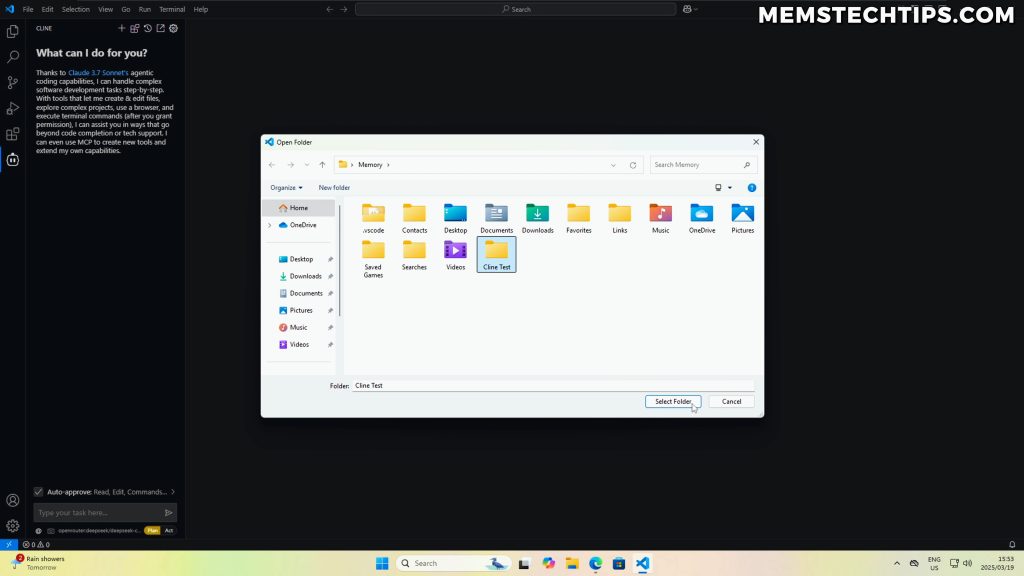
8. Create a Project Folder
- Go to File > Open Folder to create a workspace for your project
- Create a new folder for your project and select it
- This folder will serve as your workspace for the project
Creating Your First Application with Vibe Coding
Now that your environment is set up, let’s create a simple application to demonstrate the power of Vibe Coding:
1. Plan Your Project
- Decide what you want to build before engaging with the AI
- Consider the features, UI design, and functionality you want
- This planning phase is crucial for getting good results from the AI
2. Craft Your Prompt
The quality of your prompt significantly impacts the quality of the code the AI generates. Here’s an example of a well-structured prompt:
Create a C# WPF application that gives users the ability to toggle the start menu on the taskbar in Windows 11 between centered and left aligned. Use a registry entry to accomplish this. Give the user either a button or slider that helps them toggle between these two alignments. The window can be simple, but modern.

Notice how this prompt:
- Specifies the technology (C# WPF)
- Clearly describes the functionality (toggling taskbar alignment)
- Mentions implementation details (using registry entries)
- Provides UI guidance (button or slider, simple but modern)
3. Use Plan Mode First
- Start in Plan mode to let the AI architect a solution before implementation
- Review the AI’s proposed approach and make adjustments if needed
- Once satisfied with the plan, switch to Act mode for implementation

4. Let the AI Generate the Code
- In Act mode, the AI will start creating the necessary files for your application
- It will handle creating the project structure, UI elements, and functionality
- The AI may need to install dependencies or SDKs, which it will request permission for

5. Handle Any Errors
- If the application fails to build or run, copy the error messages and paste them back to Cline
- The AI will analyze the errors and make the necessary corrections
- This debugging process helps you learn more about how the code works

6. Test the Application
- Once the application builds successfully, run it to test the functionality
- Verify that it works as expected (in our example, toggling the taskbar alignment)
- Make note of any improvements or changes you’d like to make

7. Request Improvements
- If you want to enhance the application, simply describe the changes you want
- For example: “Can you make the UI more modern with rounded corners and a dark theme option?”
- The AI will update the code to implement your requested changes
Comparing AI Models for Vibe Coding
Different AI models produce significantly different results, even with identical prompts. Here’s a comparison based on a simple website creation task:
Free Models (e.g., DeepSeek Chat)
- Produce functional but basic implementations
- May lack sophisticated features or polished UI
- Good for simple projects or learning the basics

Premium Models (e.g., Claude 3.7 Sonnet)
- Create more sophisticated, feature-rich implementations
- Include additional features without being explicitly asked
- Generate cleaner, more maintainable code
- Better at understanding and implementing visual feedback from screenshots

Cost Considerations
While premium models like Claude 3.7 Sonnet produce better results, they come with a cost. For example, creating a complete website with Claude 3.7 might cost around $0.50-$1.00 in API usage. For many projects, this cost is negligible compared to the time saved and quality of results.

Common Pitfalls to Avoid
As you get started with Vibe Coding, be aware of these common mistakes:
Note: Even experienced developers can fall into these traps when first using AI coding tools. Don’t worry if you make these mistakes – they’re part of the learning process.
- Trusting the AI too much, especially with large codebases where hallucination problems can occur
- Allowing AI to dictate project direction rather than maintaining clear creative control
- Not documenting guidelines for the AI to follow
- Skipping the planning phase and diving straight into coding
Important: As a beginner, you will naturally trust the AI more since you don’t have experience to guide you. This is okay! The process of troubleshooting AI mistakes actually accelerates your learning about how code works.
Vibe Coding Workflow
For the most efficient Vibe Coding experience, follow this workflow:
- Plan your project – Decide on your idea, UI design, and feature set before engaging with AI
- Document guidelines – Create clear instructions for the AI to follow
- Provide clear, specific prompts – Be detailed about what you want to build
- Review the output – Check the generated code for any errors or issues
- Iterate and improve – Use feedback from testing to refine your application

Conclusion
Vibe Coding represents a fundamental shift in how software is created. By leveraging AI models like Claude 3.7 Sonnet through tools like the Cline extension for VS Code, anyone with an idea can bring it to life without extensive coding knowledge.
I started with zero coding experience just a year ago, and through Vibe Coding, I’ve created multiple functional applications including UnattendedWinstall, WIMUtil, and Winhance. The barrier to entry for software development has never been lower.
Whether you’re looking to create a simple website, a mobile app, or a desktop application, Vibe Coding provides a pathway to turn your ideas into reality. The technology is evolving rapidly, with new and improved models being released regularly.
Remember that while you don’t need to understand every line of code, the process of working with AI and troubleshooting issues will naturally increase your understanding of how software works. This knowledge will make you more effective at prompting the AI and creating more sophisticated applications over time.
Start with small projects, learn from the process, and gradually tackle more complex ideas. The future of software development is here, and it’s accessible to everyone.
Frequently Asked Questions (FAQ)
Do I really need zero coding experience to use Vibe Coding?
Yes, you can start with absolutely no coding experience. The AI handles the technical implementation based on your natural language descriptions. However, as you work on projects, you’ll naturally pick up coding concepts which will help you create more sophisticated applications over time.
Which AI model is best for Vibe Coding?
Currently, Claude 3.7 Sonnet by Anthropic provides the best results for coding tasks. It generates more sophisticated, feature-rich implementations compared to free alternatives. However, free models like DeepSeek Chat or Google’s models can still produce functional code for simpler projects.
How much does it cost to use Vibe Coding?
You can get started with Vibe Coding completely free using models available through OpenRouter. Premium models like Claude 3.7 Sonnet have a cost, but the cost is minimal compared to the time saved and quality of results. VS Code and the Cline extension are free.
Can Vibe Coding create any type of software?
Yes, Vibe Coding can be used to create virtually any type of software including websites, mobile apps, desktop applications, scripts, and more. The complexity and sophistication of what you can build will depend on the AI model you’re using and how well you can describe what you want.
Will Vibe Coding replace traditional programming?
While Vibe Coding dramatically lowers the barrier to entry for software development, it’s unlikely to completely replace traditional programming. Instead, it’s transforming the role of developers to focus more on problem-solving, design, and prompt engineering rather than manual coding. Even experienced developers are using these tools to accelerate their workflow.




Thank you for your video and this guide. I used it to create a Windows application that takes square screen captures! It was just an experiment but really fun.
Great article,
thanks very much for the guide and info.
I also bought yr Winhance Apps as well and can’t wait to use it.
I have never been a coder, I always found it to hard, so instead I went
and Built the Businesses instead and the first soft7ware I designed was called
“TeleBlitz” and the code was called “DataFlex” and it was an automatic Booking, Accounting, Job, Quality Call CRM
software for my pest control business.
I had 18 Sales Ladies, i would write their telescript, and bought auto dialers, so they just pushed a button and the dialer would dial their phone. It would auto Dial every person in a house in my local suburb, for the whole of Brisbane Queensland tens of thousands of people and my sales girls would chat to customer, sell a job,
My Phone Bill for my first year was just over AUD $45,000
then they could use the sames software to book and enter A Pest Control Service,
slot it into the booking table, price, times description etc.
Then it would print the jobs out for each of the 7 technicians in order of time,
then once the job was done,
the same software allowed my account girls to go back to same job, mark it as completed,
enter in the amount paid, and any up-sell amount,
then it would slot that job in to the Quality Control Queue ready for the Customers Quality Control Call in 24 hours.
After that is would also Book that Customer in to the rest of the Years 3 quality Control calls, at every 3 months.
Then it would become my accounting software, because all the data it tracked in real time, was always then passed through to my own office, so i never had to leave my office when I wanted to know how much work we had on, who was selling, how the technicians were going, quality control feedback,
To run that software I had bought 10 x 286 Computers one for each Of the sales ladies and Office manager and One 486DX for myself to hold the data.
And that was my first Software Program and it did a great job, it was so successful, at keeping my numbers correct it helped us Win Two First Place Business Awards, except the only problem I had, is I just wish these Coders would do what we ask them to do, because I had to sack the first coder because he was really unprofessional, late, missed deadlines, brought his girlfriend to work, and it was the right call, because i ended up with a much smarter, more disciplined coder the next time.
I mean those computers cost me a small fortune about $25,000 and they were so slow to be honest compared today, it was the early 1990’s just as the internet was starting, and pc’s were beginning to become more common, still basic, but they got me started and they did the job.
I have to admit to you, for me personally that was a huge job to to design, think about, fix bugs, make sure the features and benefits worked well together because I had never been involved in software before that.
I got told later by one of the Business Award Judges, that the Computer Software Manual I had written, and Printed Manually, in Full Colour on Two – 6 Colour 1200DPI Epson High Res Printers took two long weeks of Big days and nights just to print, was the best he had seen and he had never even heard of or seen a pest control company having or using something like this.
He asked if he could keep it.:
(side note: so i gave it to him, and to my surprise, he came back to me about one year later and asked me with his Partner if I would design their new companies branding, logo, marketing, promo materials etc and I accepted. But I told him i am no expert, just a wanne be that enjoys it, but he would not take no for no answer.
He then asked me to design and write his Business Awards Entry into the Self Storage Australasian Business Awards, Aussie and NZ, and I love design work, I’m just no good at it.
Anyway short story, they went down to Melbourne for the big awards nite, 1000+ business people, and when they got back a couple of days later, they called me to share, that they had taken out Winners First Place for the Brisbane Company, 400 units, in their very First Year of that company and it must of been one of those lucky days, I also Won First Place for the Best Business Presentation )
Sorry I don’t mean to blow my own horn, forgive me, I just wanted to make the point that when yr in business you have to be in marketing mode 100% of the time because you just never know.
I never did design another software, as I loved the business side too much and preferred to build and sell companies instead and went on to build 8 of them sold 5, won 7/7 first Place bus awards, It’s amazing none of them went broke to be honest, came close a few times.
That was until two weeks ago,
Until two weeks ago I tried that Base 44 out, AI Coding out and I was absolutely amazed in the space of a few hrs I designed and built a Stock Program, that is Live, i also got it to build me a Stock Portfolio feature, whereby if I put in my personal and business interests in, it will design and pick me a stock portfolio centred around those likes of mine.
It also has Live Financials News. Graphs, Updates alerts,
I have called that Product and it’s website:- http://www.FIN.ooo, (Financial Investment Numbers) i just have to put it up now.
So i am really enjoying it after decades of being to scared to try.
thanks sorry this got really long.
I ‘m off like the wind see ya, thanks again.
The Kiwi <3
Wow I must say, what you’ve accomplished sounds very impressive.
Also, thanks so much for the financial support, I really appreciate that!
Yeah AI is just becoming better and better by the day, I haven’t used Base 44 at all, I prefer to do this in an IDE and/or the Terminal, but those types of apps are great for starting a project.
I tried accessing the website, but it doesn’t seem to work.